Explanation
Architecture
Browser (Smart Labeler client)
  │  @icicle-ai/video-segmentation
  │
  ├── SAM3 Video Service (GPU node) ──── upload, frame extraction, tracking jobs,
  │      (optionally behind the            MP4 / COCO rendering
  │       auth gateway)
  │
  ├── Auth gateway ──────────────────── Tapis sign-in, dataset export to HPC
  │
  └── Tapis Files API ───────────────── HPC video download, MP4 / COCO save
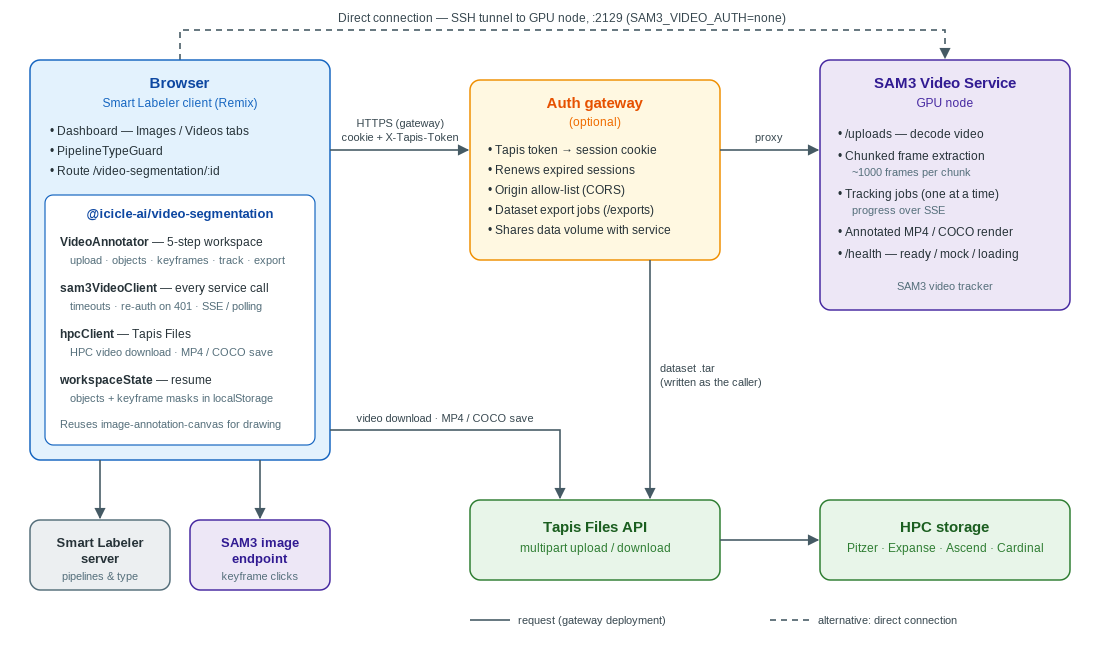
The workspace is the @icicle-ai/video-segmentation package. The client route supplies only the pipeline ID and the Tapis token. All calls to the SAM3 Video Service go through one typed client, sam3VideoClient.ts.
Keyframes and Tracking
You annotate a few keyframes; the SAM3 video tracker propagates each object's mask through the rest of the video. Each object has a stable ID shared across keyframes, which tells the tracker the masks belong to the same object. With Track both directions, an object is followed backward from its earliest keyframe as well as forward.
Tracking runs as a job on the service. Progress streams to the browser over Server-Sent Events and falls back to polling when a proxy buffers or strips the stream. A new job replaces the previous results.
Frame Indexing and Chunks
Frames are addressed by the service's decoded frame index, never by timestamp × frame rate. That is why the workspace fetches frames as images rather than playing the video in a video element: on a variable-frame-rate recording, a timestamp would drift away from the frame the tracker means.
Long videos are split into chunks of about a thousand frames. Opening a chunk extracts its frames on the service. The frame browser fetches only the frame you settle on, cancels requests you have scrolled past, and pre-fetches neighbouring frames once the current one has loaded — frames often travel over an SSH tunnel.
Authentication
On a direct connection, requests carry no credentials. The bare service allows any origin, and browsers refuse credentialed requests to a wildcard origin.
Behind the auth gateway, the Tapis token is exchanged for a session cookie, which also authenticates the progress stream (EventSource cannot send custom headers). The token is additionally sent as an X-Tapis-Token header on every request, so the workspace still works when embedded in another site that blocks third-party cookies. An expired session is renewed automatically.
Output Formats
- Annotated MP4 — the source video with coloured masks drawn on it, for review and sharing.
- COCO JSON — per-frame instance masks for every tracked object, compatible with tools such as CVAT and Roboflow and frameworks such as MMDetection and Detectron2.
- Dataset archive (
.tar) — the extracted frames plus, when a tracking job has finished, its masks and COCO JSON. Built and written to HPC by the gateway so hundreds of megabytes never pass through the browser.
Limitations
- Resume state lives in the browser's
localStorage, so it does not follow you to another device. - The service runs one tracking job at a time.
- The annotated MP4 is rendered on first request and can take several minutes for long videos.
- Dataset export to HPC requires the auth gateway.